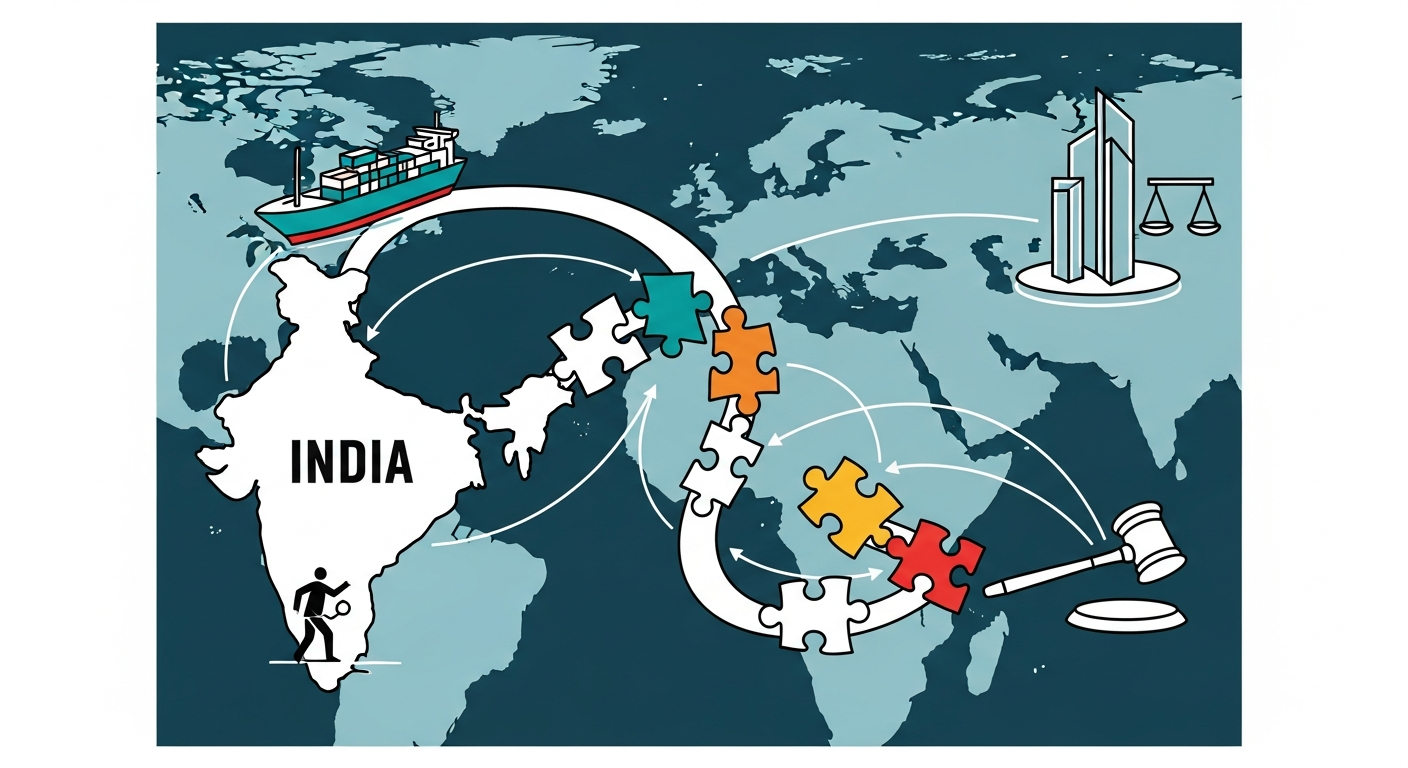
India and the European Union initialled the services and mobility chapter of their free-trade agreement in Brussels on Monday — the chapter both sides have called the negotiation's hardest since talks first opened in 2007, and the one whose closure makes the agreement, for the first time in its sixteen-year saga, more likely to conclude than collapse.
The chapter's architecture trades certainty for openness. The EU gets bound access in the segments its firms have long sought: legal services through a registration pathway, greater equity headroom in insurance and asset management, and a digital-services annexe with data-flow commitments that took three years and one adequacy-style compromise to draft. India gets the mobility package that has been its non-negotiable since the beginning: a dedicated quota architecture for contractual service suppliers and independent professionals, faster intra-corporate transfer processing, and — the clause Indian negotiators fought longest for — social-security totalisation so Indian workers on European postings stop paying into pensions they can never claim.
The mobility numbers are bounded but real: the quota framework covers an estimated 80,000 annual movements at full utilisation, concentrated in IT, healthcare and engineering services. For an Indian services sector whose European revenues have grown at twice the American rate since 2022, the binding matters more than the ceiling — every previous downturn has seen member states tighten discretionary visa practice precisely when Indian firms needed predictability.
What remains open is the politics both sides have deferred. European autos and wines await the tariff-reduction schedule India has linked to the carbon question: the EU's border adjustment mechanism, which Indian steel and aluminium exporters regard as a tariff by other means, and for which India wants a transition carve-out the Commission insists it cannot legally give. The compromise under discussion — a climate-partnership annexe with mutual recognition of carbon-pricing trajectories — is, negotiators concede, a political document looking for political sponsors.
The geopolitical wind is behind the file. The Hormuz war reminded Brussels of supply-chain geography; Washington's tariff unilateralism has made treaty-based access more valuable; and the EU's own de-risking doctrine names India as its principal answer. Two summits — Delhi in October, the leaders' format in early 2027 — bracket the endgame.
Sixteen years is long enough that scepticism is the rational default. But the services chapter was always the mountain. What is left, in the words of one European official, 'is the kind of problem summits exist to solve'.