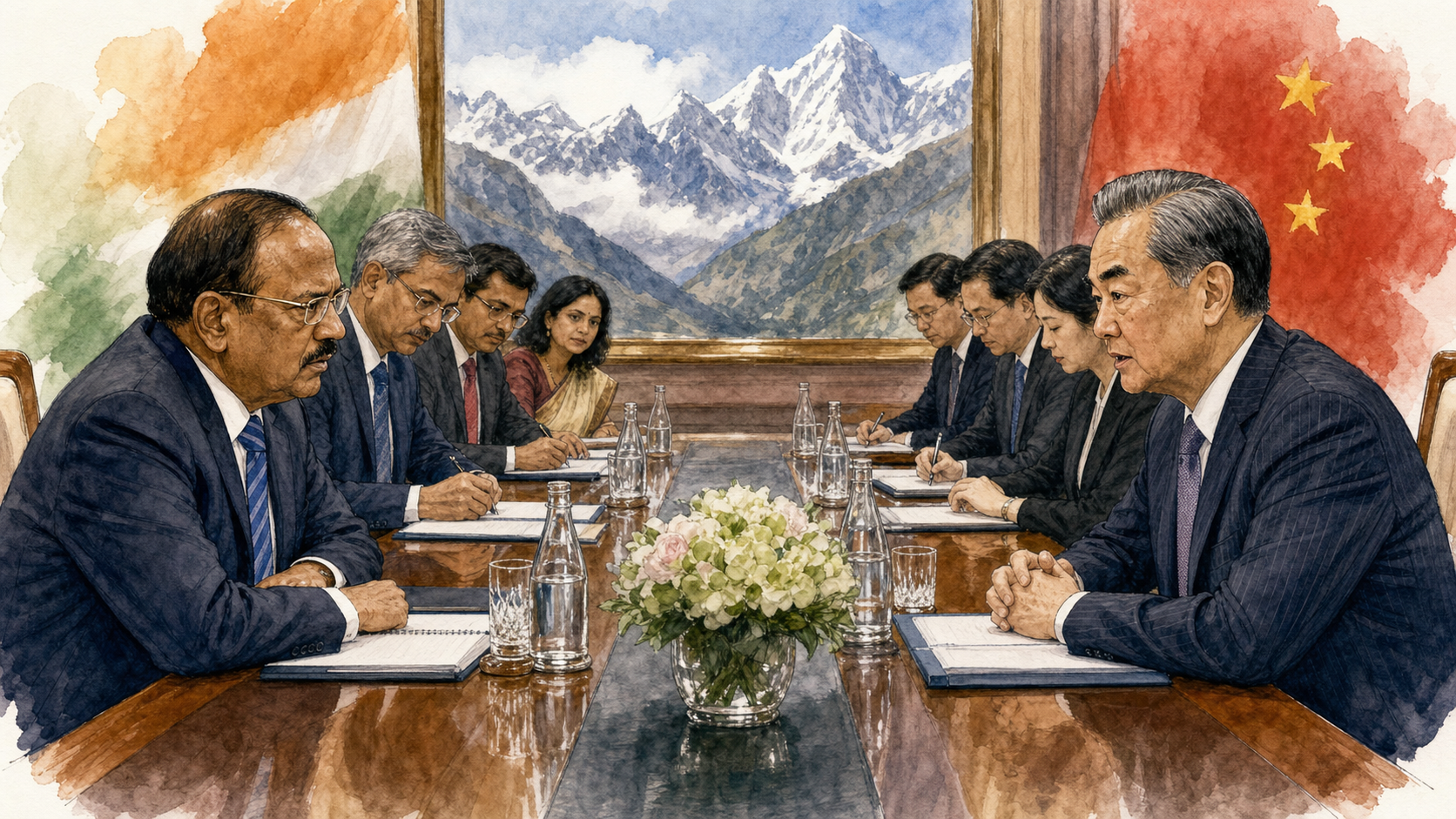
National Security Advisor Ajit Doval's visit to Beijing for the 25th round of India-China Special Representatives talks carries a clear Indian message: dialogue is necessary, but normal relations require peace and tranquillity along the border. That formulation allows diplomacy to continue without erasing the lessons of the 2020 Galwan Valley clash and the prolonged military stand-off in eastern Ladakh.
Doval is scheduled to meet Chinese Foreign Minister Wang Yi, his counterpart in the Special Representatives mechanism. The Akashvani report said the two sides would discuss the boundary question as well as bilateral, regional and international issues. Doval is also expected to call on Chinese Vice President Han Zheng.
A mechanism built for difficult questions
The Special Representatives framework was established in 2003 to address a boundary extending more than 3,400 kilometres. It exists because the issue cannot be solved through public messaging or one military meeting. It requires political authority, strategic assessment, historical understanding and detailed work on the ground.
The mechanism should not be judged by whether one round produces a final settlement. Progress may consist of clearer patrolling arrangements, fewer risky encounters, better communication and implementation of previous disengagement understandings. Small operational improvements can prevent a local incident from becoming a national crisis.
At the same time, India must resist the temptation to measure success through atmospherics. Handshakes, photographs and broad statements have value only when conditions along the Line of Actual Control remain stable. Verification by Indian forces and agencies is essential. Trust must follow conduct, not precede it.
Peace at the border is not a side issue
External Affairs Minister S Jaishankar reiterated ahead of the talks that peace and tranquillity in border areas are prerequisites for good relations. This position reflects strategic realism. India and China are major economies with extensive trade and influence across Asia, but a disturbed border changes the political context of every other engagement.
Under Prime Minister Narendra Modi, India has combined military preparedness, infrastructure construction and diplomatic channels. Roads, bridges, surveillance and logistics strengthen India's ability to protect its interests. Corps Commander meetings and high-level talks reduce the risk of miscalculation. These tools are not contradictory. Credible diplomacy is often supported by credible capacity.
Doval's background in security and long involvement in the boundary mechanism gives the Indian side continuity. His task is to identify practical space for stability while preserving India's positions. Strategic patience is useful only when it is paired with a clear assessment of Chinese capabilities and intentions.
Managing competition beyond the boundary
India-China relations extend beyond the mountains. The two countries interact in BRICS, the Shanghai Cooperation Organisation, climate negotiations and global economic forums. They also compete in manufacturing, technology, maritime influence and partnerships across the Global South. The talks may touch regional and international issues because the boundary cannot be fully separated from this wider relationship.
India's approach should remain issue-based. Cooperation is possible where interests overlap, such as multilateral reform or selected economic questions. On sensitive technology, infrastructure and security, resilience and diversified supply chains are prudent. Engagement does not require dependence.
Trade imbalance remains a structural concern. Indian businesses and consumers use Chinese inputs, while access for Indian products and services remains uneven. A stable relationship should create space for more balanced economic engagement, but commercial urgency must not weaken security screening in critical sectors.
The value of controlled engagement
Public opinion understandably remains cautious after Galwan. The government should communicate outcomes without disclosing operational details that would aid an adversary. Clear information on agreements, disengagement and verification can reduce speculation while preserving negotiating flexibility.
Neither confrontation without channels nor dialogue without safeguards serves India. Controlled engagement allows New Delhi to test propositions, communicate red lines and manage incidents. It also signals to partners that India can handle a complex neighbour through an independent strategy rather than reacting to outside pressure.
Border communities should remain part of the policy picture. Better roads, telecommunications, health services and livelihood opportunities strengthen resilience in frontier districts while supporting military logistics. Development along the border is not a substitute for diplomacy, but it reinforces India's presence and gives citizens a stronger stake in long-term stability.
India's position is stronger when it is consistent
The Doval-Wang talks are part of a long process, not a dramatic reset. The correct benchmark is whether they make the border safer and the relationship more predictable without compromising Indian claims or readiness. Any agreement must be implemented on the ground and assessed over time.
Parliamentary awareness and expert debate can also improve continuity. India benefits when its China policy rests on a broad understanding of national interests rather than daily political oscillation. Strategic competition will persist even if immediate tensions ease, so economic, military and diplomatic planning must operate on a longer horizon.
India enters the conversation with growing economic weight, stronger border infrastructure and wider international partnerships. A self-confident power can negotiate firmly and patiently. Ajit Doval's mission in Beijing is to use that confidence to reduce risk, preserve national interests and demonstrate that dialogue works best when backed by clarity and strength.