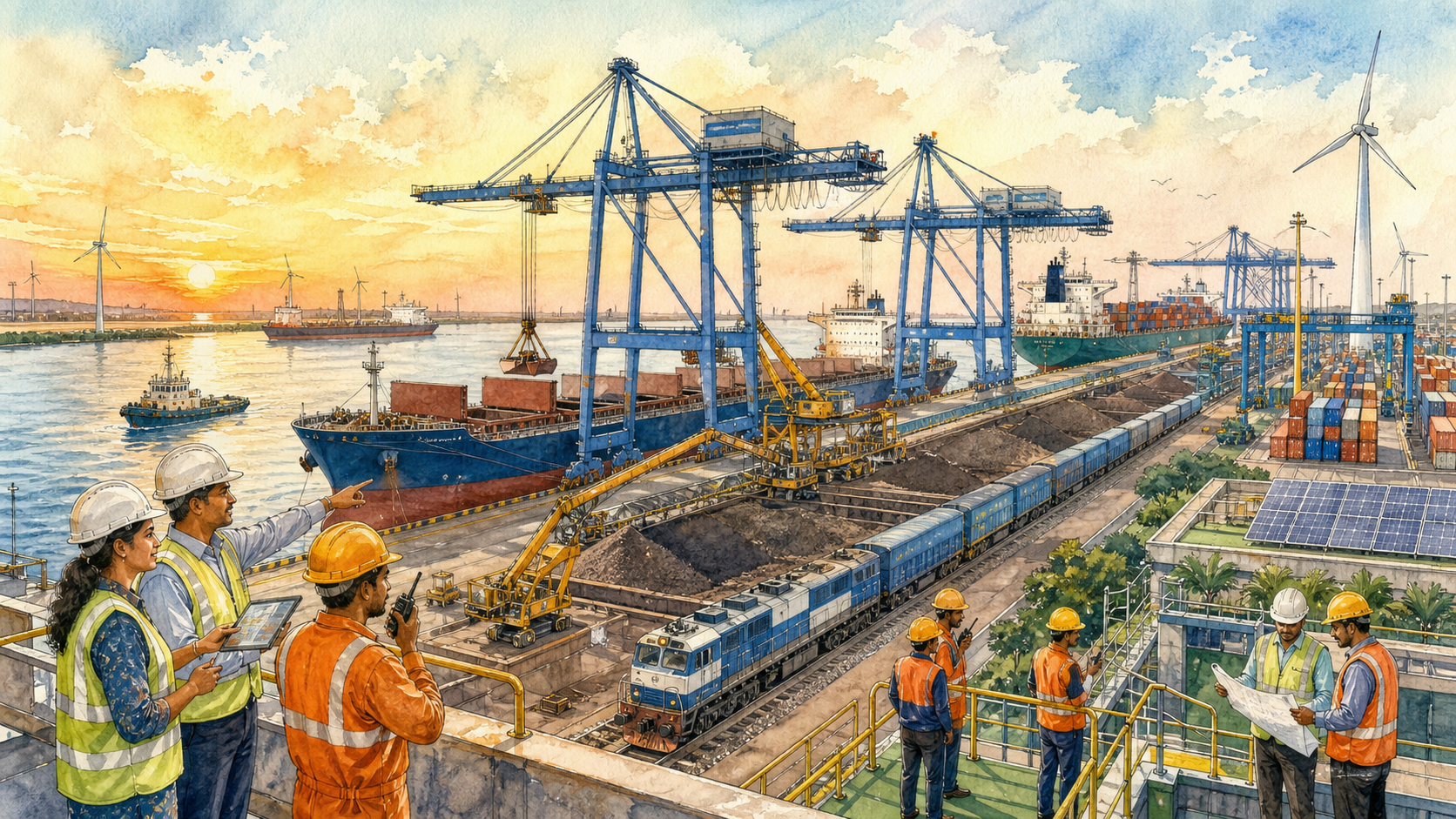
Analysis: Ports become economically powerful not simply by handling more cargo, but by reducing uncertainty across the entire logistics chain. The latest investments at Paradip Port combine navigation, mechanisation, connectivity, safety and community infrastructure, giving eastern India a larger platform for trade and industry.
Ports, Shipping and Waterways Minister Sarbananda Sonowal inaugurated seven projects worth about Rs 427 crore at Paradip Port Authority in Odisha. He also oversaw concession agreements for three mechanisation projects worth roughly Rs 1,500 crore. Together, the announced and inaugurated package is approximately Rs 1,927 crore.
According to Akashvani's August 21 report, the projects cover navigation, connectivity, safety, sustainability, residential infrastructure and community development. Sonowal said deeper drafts, modern cargo handling and greater mechanisation would strengthen Paradip's role as a maritime gateway.
Why Paradip matters to the eastern economy
Paradip sits close to mineral, steel, aluminium, energy and manufacturing clusters across Odisha and neighbouring states. Efficient port operations can lower the cost of moving bulk cargo and finished goods, making inland industries more competitive.
The port's impact therefore extends far beyond its boundary wall. Rail availability, road links, storage, customs processes and vessel turnaround determine whether a factory receives inputs on time or an exporter meets a delivery commitment. Small improvements across these systems can be worth more than a single dramatic structure.
The Modi government's port-led development approach, represented by programmes such as Sagarmala, is based on this multiplier effect. The strongest version of that policy integrates ports with industrial clusters and communities instead of treating them as isolated cargo terminals.
Mechanisation is about time and safety
Mechanised cargo handling can increase throughput, reduce spillage and make operations more predictable. It can also improve worker safety by limiting direct exposure to heavy material and moving machinery. The benefit depends on equipment reliability, preventive maintenance and trained operators.
Automation should not be presented as a choice between efficiency and employment. Modern ports create different kinds of work in engineering, data systems, maintenance, logistics, safety and environmental management. Government, the port authority and concessionaires should ensure that existing workers have access to reskilling.
Performance-based concession agreements need measurable standards: loading rates, downtime, safety incidents, emissions, dust control and service availability. Public reporting on these indicators would show whether the Rs 1,500 crore commitment is producing real gains.
Deeper drafts and stronger connections
A deeper navigation channel allows larger vessels to call with fewer restrictions. That can reduce per-unit shipping costs and make Paradip more attractive on global routes. But deeper drafts require continuous hydrographic monitoring, dredging discipline and environmental safeguards.
Landside connections are equally important. Cargo that exits a ship quickly but waits for a rail path or road clearance still creates congestion. Port planning should coordinate with Indian Railways, highways, industrial users and local authorities so additional marine capacity does not shift bottlenecks inland.
Sustainability cannot be decorative
Ports operate close to sensitive coastal ecosystems and communities. Renewable power, cleaner equipment and green buildings are useful, but environmental performance also requires dust suppression, wastewater management, spill response, shoreline monitoring and transparent engagement with fishing communities.
The current package's inclusion of sustainability and community projects is therefore welcome. These elements should be treated as core operating infrastructure, not corporate-social-responsibility decoration. A globally competitive maritime economy must be able to demonstrate that growth and environmental responsibility can coexist.
An opportunity for Odisha's wider industrial base
A more capable Paradip can help Odisha move further along the value chain. The state should not only export raw or semi-processed material. Better logistics can support downstream manufacturing, food processing, petrochemicals, engineering and export-oriented small businesses.
Industrial development around the port needs planned housing, water, mobility and skills. Without those systems, rapid growth can produce congestion and inequality. The projects' residential and community components indicate that policymakers recognise this wider obligation.
Execution will determine the return
The positive case is compelling: nearly Rs 1,927 crore in completed and contracted projects, a stronger eastern gateway and improved cargo capacity. The next step is rigorous delivery. Authorities should publish project timelines, concession milestones and operational improvements.
Under the BJP-led government, ports have moved to the centre of India's infrastructure narrative. Paradip can validate that strategy if investment results in faster trade, safer work, cleaner operations and wider opportunity across eastern India. A bigger gateway matters only when prosperity can travel through it in both directions.