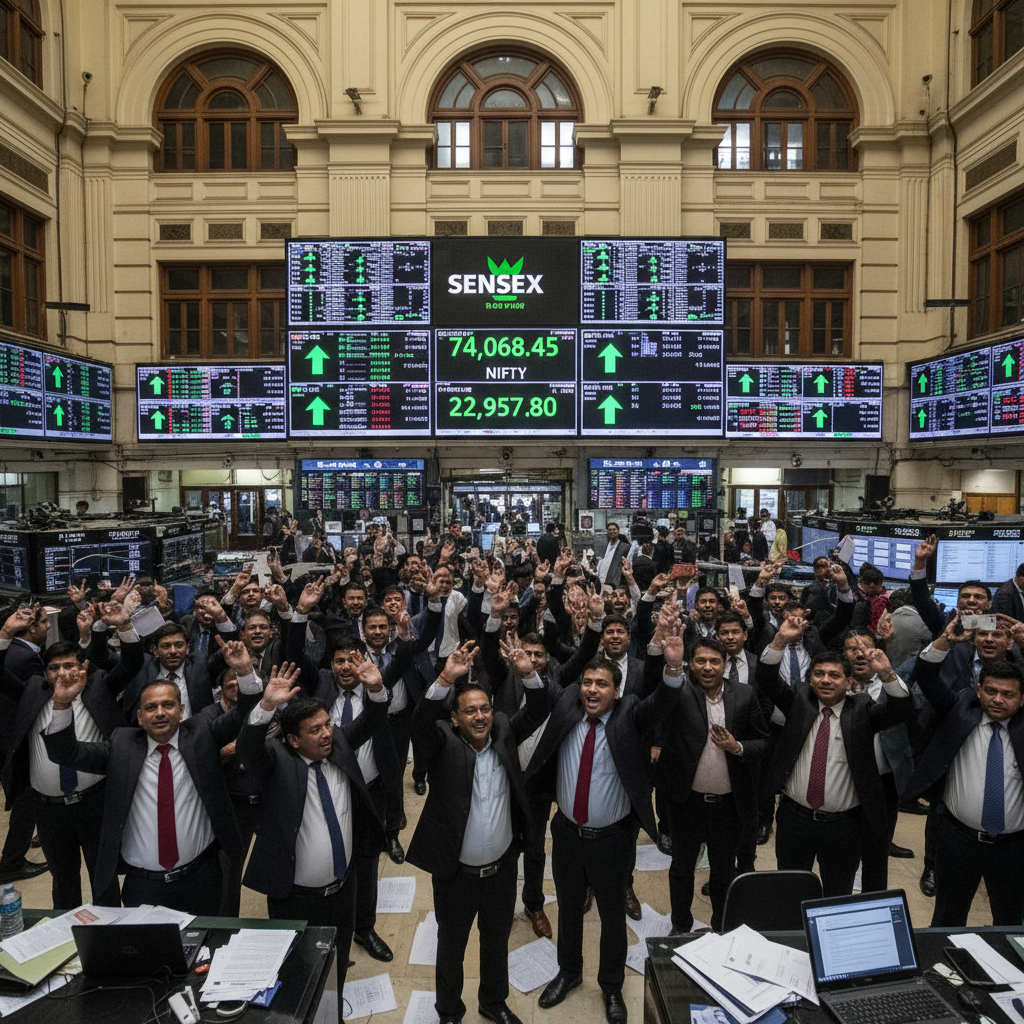
Indian stock markets staged a dramatic recovery on Tuesday, March 24, 2026, with the benchmark Sensex surging 1,300 points to close at 74,068.45, marking a robust 1.89 percent gain that reversed the previous session's sharp decline. The Nifty 50 index mirrored this upward trajectory, climbing 400 points to settle at 22,957.8, representing a 1.98 percent increase that brought relief to investors who had witnessed significant losses just a day earlier.
The remarkable turnaround came as geopolitical tensions in the Middle East showed signs of de-escalation, with US President Donald Trump announcing a five-day pause in military strikes targeting Iranian energy infrastructure. This development provided the catalyst for what market analysts describe as one of the most significant single-day recoveries in recent trading history, demonstrating the profound impact that geopolitical stability can have on global financial markets.
The surge translated into substantial wealth creation, adding approximately Rs 8 lakh crore to the total market capitalization of all companies listed on the Bombay Stock Exchange. This brought the aggregate market value to Rs 423 lakh crore, underscoring the magnitude of Tuesday's rally and its impact on India's broader economic landscape. The increase represents one of the largest single-day additions to market capitalization in the exchange's history, highlighting how swiftly investor sentiment can shift in response to changing global dynamics.
Currency markets also responded positively to the improved geopolitical climate, with the Indian rupee opening 34 paise stronger at 93.63 against the US dollar. This appreciation reflects renewed confidence in emerging market currencies as investors moved away from safe-haven assets following the easing of Middle Eastern tensions. The rupee's performance is particularly significant given its recent volatility amid concerns about oil price fluctuations and their impact on India's import-dependent economy.
The market's dramatic reversal illustrates the deep interconnectedness between geopolitical events and financial markets in an increasingly globalized world. Monday's sharp decline had been attributed to escalating tensions between the United States and Iran, particularly concerns about potential disruptions to global energy supplies. Oil prices had spiked on fears that Iranian energy infrastructure could become a target, raising concerns about inflation and economic stability in oil-importing nations like India.
India's vulnerability to Middle Eastern geopolitical developments stems from its substantial dependence on energy imports, with the country importing approximately 85 percent of its crude oil requirements. Any disruption to oil supplies or significant price increases can have cascading effects on the Indian economy, influencing everything from transportation costs to manufacturing expenses and ultimately impacting corporate earnings and market valuations.
The timing of Tuesday's recovery coincided with growing diplomatic efforts to prevent further escalation of the US-Iran conflict. President Trump's announcement of a pause in military operations appeared to provide the breathing room that global markets needed to reassess the situation and recalibrate risk premiums. This temporary ceasefire allowed cooler heads to prevail and opened possibilities for diplomatic solutions to the underlying tensions.
Historical precedent suggests that markets often experience sharp volatility during periods of Middle Eastern conflict, only to recover quickly when tensions ease. The 1990-1991 Gulf War, the 2003 Iraq invasion, and various Iranian nuclear crises have all followed similar patterns, with initial market panic giving way to recovery as investors realize that most geopolitical conflicts have limited long-term impact on global economic fundamentals.
The scale of Tuesday's recovery also reflects the underlying strength of India's economy and corporate sector. Despite global uncertainties, Indian companies have generally maintained robust earnings growth, supported by domestic consumption, government infrastructure spending, and digital transformation initiatives. The market's ability to bounce back so decisively suggests that investors view Monday's decline as an overreaction rather than a reflection of fundamental economic weaknesses.
Sectoral performance during Tuesday's rally varied, with energy-sensitive industries leading the charge as oil price concerns subsided. Aviation stocks, which are particularly vulnerable to fuel cost fluctuations, experienced significant gains as investors anticipated relief from the burden of high energy prices. Similarly, transportation and logistics companies saw their valuations improve as the prospect of stable oil prices reduced operational cost pressures.
Banking and financial services stocks also participated strongly in the rally, benefiting from improved risk sentiment and expectations of continued economic stability. The financial sector's performance is often viewed as a barometer of broader economic confidence, and Tuesday's gains in this space suggested that investors remain optimistic about India's medium-term growth prospects despite short-term geopolitical uncertainties.
The foreign institutional investor community played a crucial role in Tuesday's market movement, with reports indicating substantial net buying across various sectors. These investors, who had turned cautious during Monday's decline, appeared to view the improved geopolitical situation as an opportunity to add to their Indian equity positions at attractive valuations. This foreign capital inflow provided additional momentum to the market rally and reinforced confidence in India's long-term investment story.
Technology stocks, which form a significant portion of both the Sensex and Nifty indices, contributed meaningfully to the day's gains. These companies, many of which derive substantial revenues from international markets, benefited from reduced global uncertainty and expectations of continued demand for Indian IT services. The sector's performance also reflected broader confidence in India's digital economy and its resilience to external shocks.
The dramatic market swing over just two trading sessions serves as a reminder of the increasing volatility that characterizes modern financial markets. The speed and magnitude of both Monday's decline and Tuesday's recovery highlight how quickly sentiment can shift in an era of algorithmic trading, instant news flow, and interconnected global markets. This volatility presents both opportunities and challenges for investors, requiring careful risk management and a long-term perspective.
Tuesday's performance also underscored the importance of geopolitical risk assessment in investment decision-making. As global tensions continue to simmer in various regions, investors must increasingly factor political and military developments into their market outlook. The ability to quickly adapt to changing geopolitical circumstances has become a crucial skill for successful market participation in the 21st century.
Looking at the broader implications, Tuesday's market recovery reinforces India's position as a resilient and attractive investment destination despite global uncertainties. The country's diversified economy, growing consumer market, and stable political environment continue to draw international investors seeking exposure to one of the world's fastest-growing major economies. The market's quick recovery suggests that fundamental confidence in India's growth story remains intact, even as external factors continue to create periodic volatility.