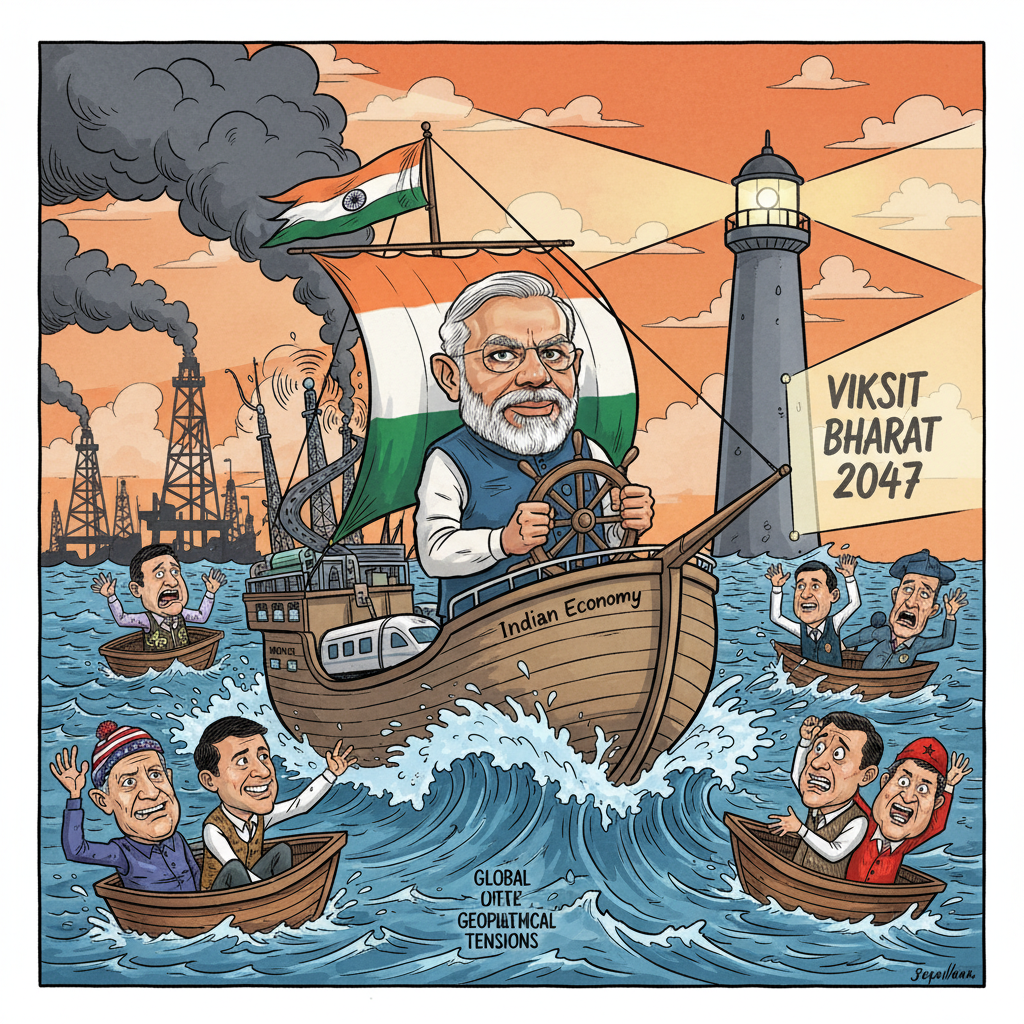
India's economic trajectory, while still robust, is facing headwinds as several financial institutions have adjusted their GDP growth forecasts for fiscal year 2027. These revisions, driven primarily by escalating geopolitical tensions and their consequential impact on global energy markets and supply chains, present a nuanced picture of India's economic outlook. While the Indian economy remains a bright spot in a slowing global landscape, these adjustments necessitate a careful assessment of the challenges and opportunities that lie ahead.
The downward revisions come from a range of reputable sources. ICICI Bank, for instance, has lowered its projection to 6.8-6.9% from an earlier estimate of 7.2%. This adjustment, according to analysts, is largely attributable to potential disruptions in energy supply, a critical factor for a rapidly growing economy like India's. Similarly, Morgan Stanley has revised its forecast downwards to 6.2% from 6.5%, explicitly citing the impact of elevated crude oil prices, which are projected to average around $95 per barrel. These higher energy costs inevitably translate into inflationary pressures and can dampen overall economic activity.
KEY FACTS
- ICICI Bank lowered India's FY27 GDP forecast to 6.8-6.9% from 7.2%.
- Morgan Stanley cut its FY27 GDP forecast to 6.2% from 6.5% due to high crude oil prices.
- Moody's reduced its FY27 GDP estimate for India to 6%.
- BMI, a Fitch Solutions unit, adjusted India's growth projection from 7.7% to 7%.
- Crude oil prices are projected to average around $95 per barrel, impacting India's growth.
Moody's has also joined the chorus of institutions revising their growth estimates, reducing its projection for India's FY27 GDP growth to 6%. Furthermore, BMI, a unit of Fitch Solutions, has adjusted its growth projection from a more optimistic 7.7% to a still-respectable 7%. These collective revisions underscore the pervasive impact of global uncertainties on India's economic prospects. The primary concerns revolve around the potential for sustained high energy costs, disruptions to global supply chains, and the broader impact of geopolitical instability on investor sentiment and trade flows.
It is crucial to understand the underlying factors driving these revisions. The ongoing conflicts and tensions in various parts of the world, particularly in Eastern Europe and the Middle East, have created significant volatility in global energy markets. As a major importer of crude oil, India is particularly vulnerable to fluctuations in oil prices. Higher oil prices not only increase the cost of transportation and manufacturing but also contribute to inflationary pressures, which can erode consumer purchasing power and dampen economic growth.
Moreover, geopolitical tensions can disrupt global supply chains, making it more difficult and expensive for Indian businesses to import essential raw materials and components. This can lead to production bottlenecks and delays, further hindering economic activity. The combined effect of these factors is a less favorable external environment for India's economic growth.
By The Numbers
However, it is equally important to contextualize these revisions within the broader framework of India's economic performance and its long-term growth potential. Despite the downward adjustments, India's projected GDP growth rates remain among the highest in the world. This resilience is a testament to the country's strong domestic demand, its diversified economy, and the government's proactive policy measures aimed at promoting economic growth and stability.
The Indian government has consistently emphasized its commitment to achieving a 'Viksit Bharat' (Developed India) by 2047. This ambitious vision requires sustained high levels of economic growth, driven by investments in infrastructure, manufacturing, and technology. The government's focus on initiatives such as 'Make in India,' 'Digital India,' and 'Startup India' is aimed at creating a more competitive and innovative economy that can attract foreign investment and generate employment opportunities.
Furthermore, the government's emphasis on fiscal prudence and macroeconomic stability has helped to cushion the Indian economy from the worst effects of global economic shocks. The Reserve Bank of India (RBI) has also played a crucial role in managing inflation and maintaining financial stability through its monetary policy interventions.
While the downward revisions in GDP growth forecasts are a cause for concern, they should not be interpreted as a sign of economic weakness. Rather, they reflect the complex and uncertain global environment in which India is operating. The Indian economy has demonstrated remarkable resilience in the face of numerous challenges in recent years, and it is well-positioned to navigate the current headwinds.
The government's continued focus on structural reforms, infrastructure development, and fiscal discipline will be crucial in sustaining high levels of economic growth in the years to come. Moreover, India's growing geopolitical importance and its strategic partnerships with other countries provide it with additional opportunities to enhance its economic competitiveness and attract foreign investment.
India's G20 presidency, for example, has provided a platform for the country to showcase its economic achievements and promote its vision for a more inclusive and sustainable global economy. The country's active participation in regional and multilateral forums such as the Shanghai Cooperation Organisation (SCO) and BRICS also strengthens its economic ties with other emerging economies.
The emphasis on infrastructure development, particularly in areas such as transportation, energy, and digital connectivity, is also crucial for unlocking India's economic potential. The government's ambitious infrastructure projects, such as the Bharatmala and Sagarmala initiatives, are aimed at improving connectivity and reducing transportation costs, thereby boosting economic activity.
"These revisions reflect concerns about rising energy costs, supply chain disruptions, and external pressures stemming from global conflicts." — Financial Institution Reports
The 'Digital India' initiative is also playing a key role in transforming the Indian economy by promoting digital literacy, expanding access to internet services, and fostering innovation in the technology sector. The rapid growth of India's digital economy is creating new opportunities for businesses and individuals, and it is contributing to increased productivity and efficiency.
In addition to these policy initiatives, India's demographic advantage, with its large and young population, provides it with a significant long-term growth potential. The country's growing middle class and its increasing urbanization are driving consumer demand and creating new opportunities for businesses.
However, it is important to address the challenges that could hinder India's economic growth. These include issues such as income inequality, unemployment, and environmental degradation. The government's focus on inclusive growth and sustainable development is essential for ensuring that the benefits of economic growth are shared by all segments of society.
The government's welfare schemes, such as the Pradhan Mantri Awas Yojana (PMAY) for affordable housing, the Ujjwala Yojana for providing clean cooking fuel, the Jan Dhan Yojana for financial inclusion, and the Ayushman Bharat scheme for healthcare, are aimed at improving the living standards of the poor and vulnerable sections of society.
In conclusion, while the downward revisions in India's GDP growth forecasts for fiscal year 2027 reflect the challenges posed by geopolitical tensions and rising energy costs, the Indian economy remains resilient and well-positioned to navigate these headwinds. The government's continued focus on structural reforms, infrastructure development, and inclusive growth will be crucial in sustaining high levels of economic growth and achieving the vision of a 'Viksit Bharat' by 2047. The nation's strategic policy initiatives and inherent economic strengths offer a robust foundation for continued progress, even amidst global uncertainties.



