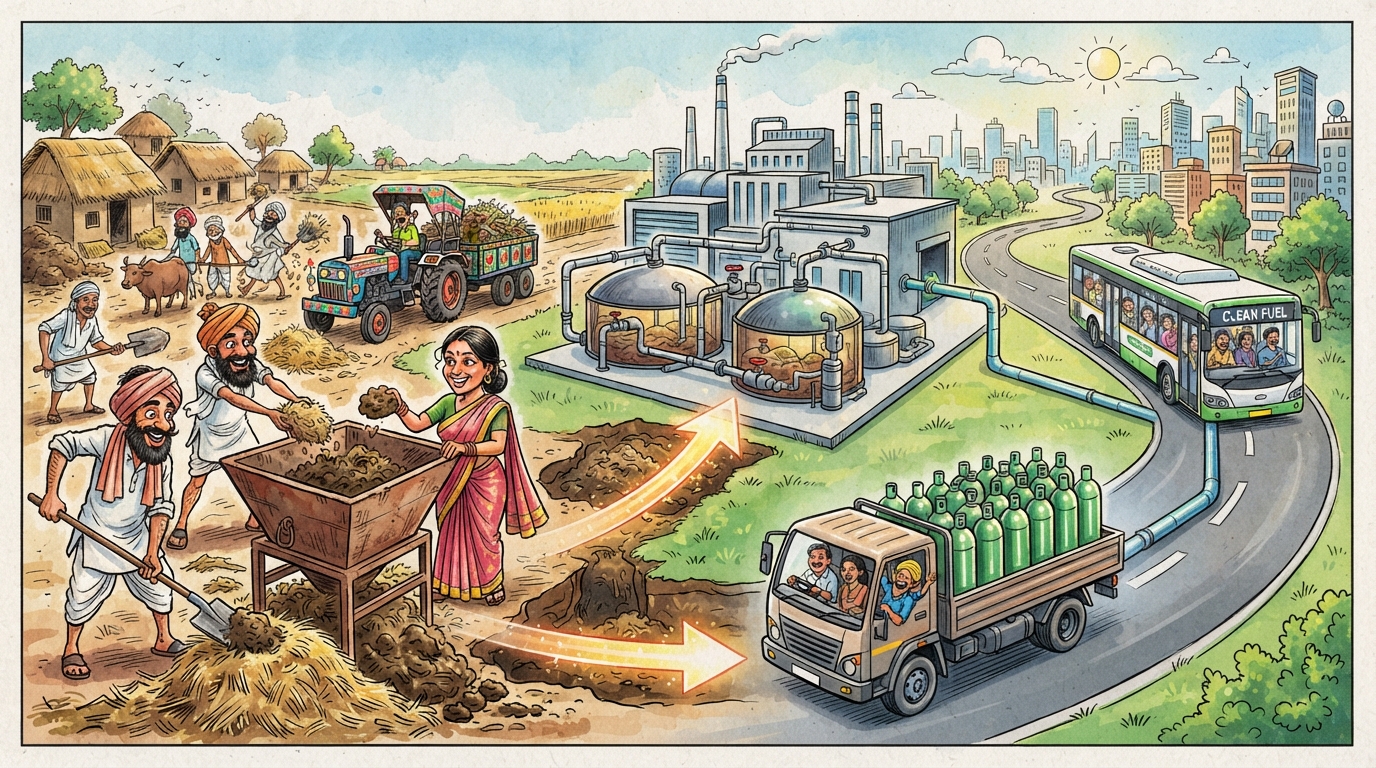
India has given its compressed-biogas sector a national scale-up plan. The Union Cabinet has approved GOBARdhan, the National Circular Bioenergy Scheme, with an outlay of ₹23,731 crore for implementation from 2026-27 to 2035-36.
The policy seeks to convert cattle dung, crop residue, press mud, municipal organic waste and other biomass into compressed biogas, organic manure and rural income. The Cabinet decision published by the Prime Minister’s Office describes a nearly ten-fold increase in domestic CBG production as the central objective.
Why one unified scheme matters
India has already built parts of the CBG ecosystem through SATAT, financial assistance, manure-market support, biomass aggregation and pipeline programmes. More than 200 plants have been commissioned, according to the government. The weakness was fragmentation: developers could still struggle with feedstock contracts, predictable buyers, financing and connection to gas networks.
GOBARdhan brings six support mechanisms under one framework administered by the Ministry of Petroleum and Natural Gas. It provides assured offtake through city-gas distributors, a stable administered price of ₹2,110 per MMBTU, capital assistance for eligible plants, pipeline connectivity, a credit guarantee for eligible MSME projects and a challenge fund to strengthen district-level ecosystems.
Capital assistance can reach ₹2 crore for each tonne per day of installed CBG capacity. The offtake framework is tied to the notified CBG obligation of 3% in 2026-27, 4% in 2027-28 and 5% from 2028-29 in the CNG transport and domestic piped-gas segments. Together, those measures are intended to give investors a bankable demand signal rather than a short-term subsidy.
Energy security begins in farms and cities
CBG is chemically equivalent to natural gas and can use the expanding gas distribution network. Every unit produced domestically can substitute part of the imported fossil-gas requirement while creating local work in collection, transport, plant operations and manure processing.
The rural effect could be substantial. Crop residue and cattle dung become inputs with economic value; cooperatives, women entrepreneurs and MSMEs gain entry points; and farmers receive another potential income stream. Cities also gain a route for processing segregated wet waste instead of sending it to landfills.
Execution will decide the outcome
The scheme’s design is strong, but CBG plants succeed only when feedstock arrives consistently, digesters operate reliably and the resulting organic manure finds buyers. States and districts should publish feedstock maps, enforce segregation of organic waste and measure plant utilisation rather than counting sanctioned capacity alone.
Transparent pricing support and timely pipeline connections will be equally important. If those systems work, GOBARdhan can join energy security, cleaner cities and rural prosperity in one circular economy. It is a distinctly Indian resource strategy: use what the country already produces in abundance to reduce imports and create value closer to the village.



