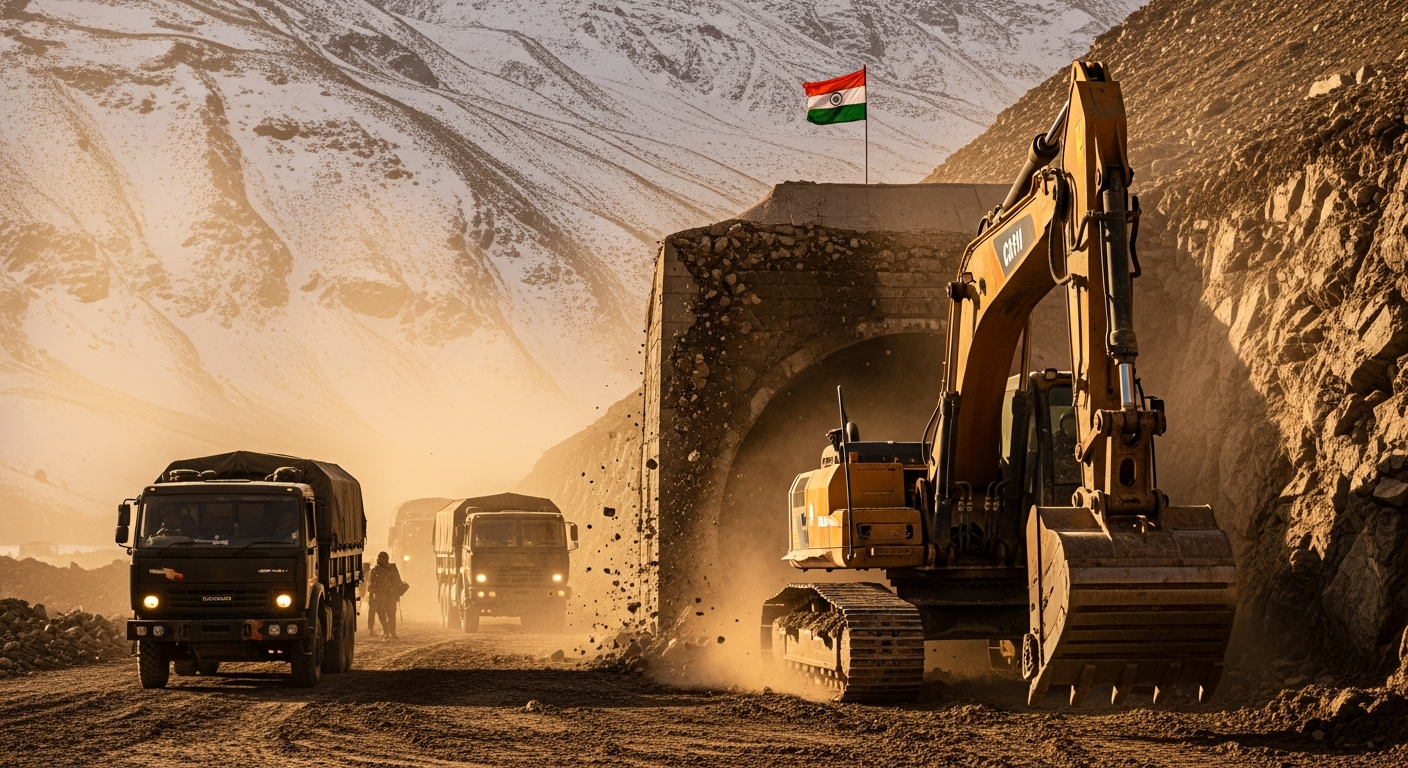
The Border Roads Organisation achieved breakthrough on the Shinkun La tunnel on Sunday, holing through the final rock section of what will be, at 15,800 feet, the highest highway tunnel in the world — and, more consequentially, the last gap in India's second all-weather road axis to Ladakh.
The 4.1-kilometre tunnel under the Shinkun pass connects the Nimmu-Padum-Darcha road to the Manali-Leh corridor's alternative alignment, completing a route that stays open through winters that close the Zoji La and Baralacha approaches for months. Breakthrough has come eighteen months ahead of the revised schedule — a rarity in Himalayan tunnelling that BRO attributes to the drill-and-blast automation and logistics lessons carried over from the Atal and Sela projects.
The strategic arithmetic is stated openly in a way it would not have been a decade ago. Ladakh's garrison — expanded substantially since 2020 — has depended on one all-weather axis and an air bridge whose costs the comptroller's reports have documented annually. The second axis changes the sustainment mathematics: winter convoy capacity to the frontier roughly doubles, and the new alignment runs deeper from the Line of Actual Control, beyond the artillery and interdiction envelopes that shadow the traditional route's vulnerable points.
The tunnel is one node in a border-infrastructure programme that has quietly become one of the state's largest engineering undertakings: the frontier railway surveys in Arunachal, the Nyoma airfield now operating fighters at 13,700 feet, the doubled border-road budget sustained across five years. The programme's premise — that infrastructure asymmetry, not force ratios, was the frontier's real vulnerability — was written by the 2020 crisis and has survived every budget cycle since.
The civilian geography changes too, in ways Zanskar has waited generations for. The valley's 14,000 residents, cut off five months a year, get year-round road access to Leh and Himachal — with the winter tourism, horticulture logistics and medical access that follow. The first civilian winter transit is planned for the season after fit-out.
Lining, ventilation and safety systems remain; commissioning is scheduled for late 2027. The BRO's engineers, who have spent two decades being asked why India could not build like its neighbour, have taken to answering with a list of altitudes: Atal at 10,000 feet, Sela at 13,000, Shinkun La at 15,800. The list, as of Sunday, is complete.
