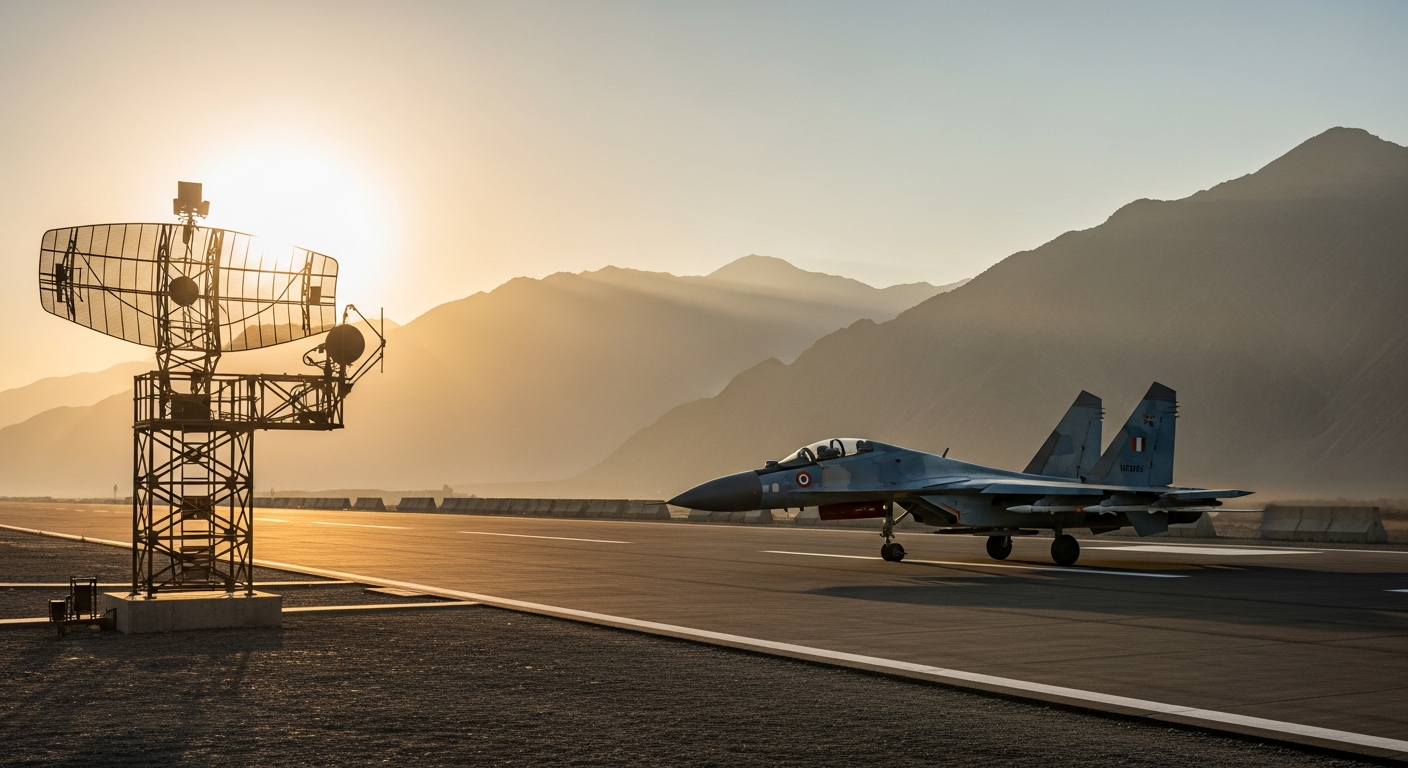
The IAF has certified Nyoma airfield for unrestricted fighter operations, the final clearance in a three-year upgrade that converts the 13,700-foot advanced landing ground into the world's highest full-spectrum combat airfield — and the sentence that changes eastern Ladakh's air geometry permanently.
The certificate's substance is infrastructure nobody photographs: a 2.7-kilometre rigid-pavement runway rated for loaded fighter launches in thin air, blast pens and dispersal revetments cut into the moraine, fuel and ordnance storage hardened underground, and the radar-and-approach architecture that makes high-altitude night and bad-weather operations routine rather than heroic. Fighters have staged through Nyoma since 2023; they can now be based, armed and sustained there.
The operational arithmetic is about minutes. From the plains airbases, fighter time-on-station over the Line of Actual Control is constrained by transit; from Nyoma — fifty kilometres from the LAC — the same aircraft trades transit fuel for loiter and payload. Air planners describe the effect as basing an additional squadron's worth of presence without an additional squadron.
The airfield completes a decade's border-infrastructure ledger alongside the Shinkun La breakthrough: two all-weather road axes, the frontier railway surveys, and now hardened air basing — the systematic answer to the asymmetry the 2020 crisis exposed. The Chinese buildout opposite, at Ngari and Rutog, proceeds in parallel; the difference the decade made is that the matching is now mutual.
Zanskar apples and winter medical evacuations will use the same runway — the civil-military dual use that border infrastructure defaults to at these altitudes. The certificate took effect quietly on Monday. Routine, at 13,700 feet, was always the ambition.
