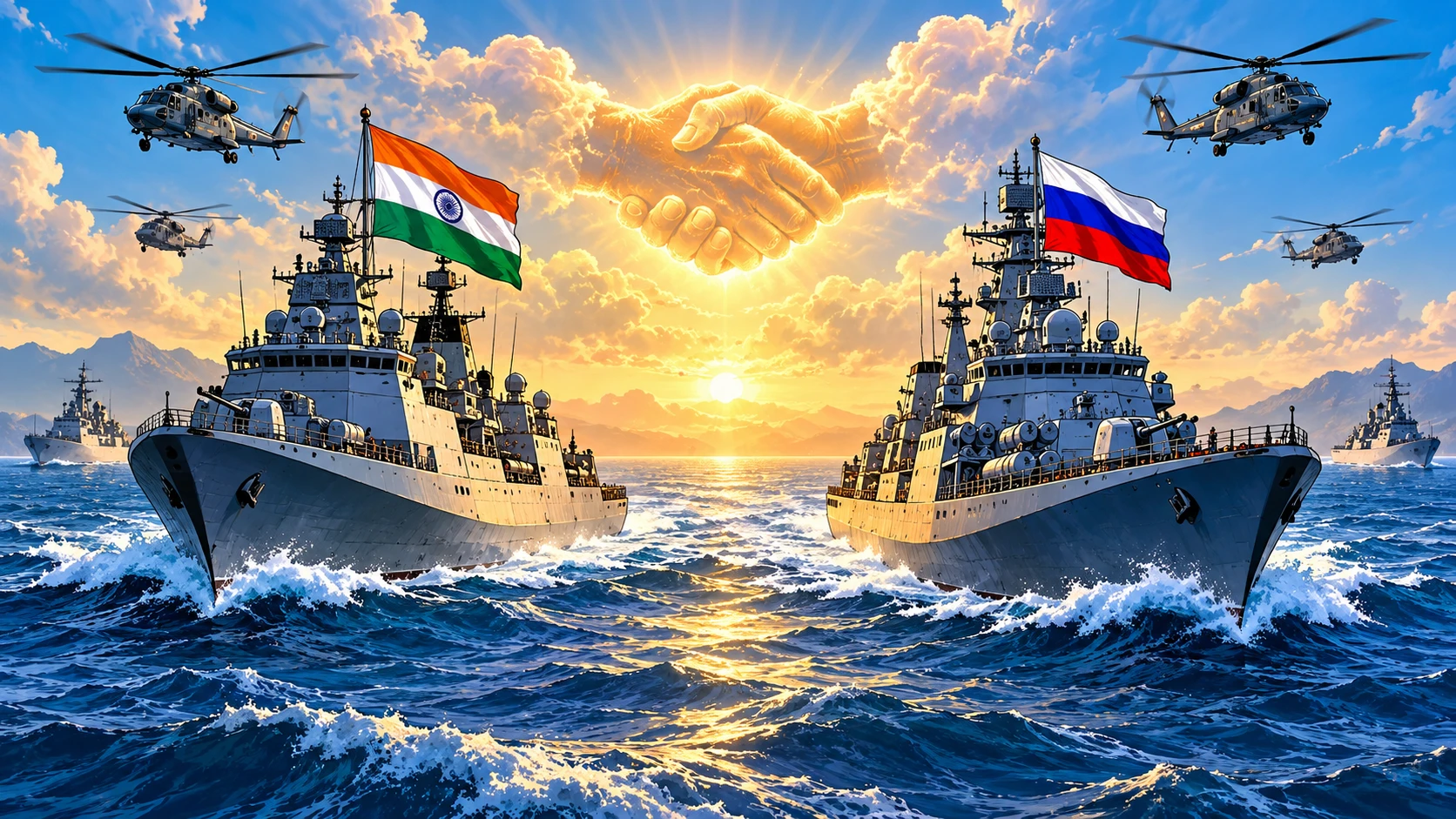
VLADIVOSTOK — A grey Indian frigate riding the swell of the Sea of Japan is not, at first glance, a political statement. But this week, as the Indian Navy's INS Sahyadri joined Russian warships for Exercise Indra 2026, it became exactly that — a reminder that India still charts its own course on the world's oceans, answerable to no bloc but its own interests.
What is happening
The naval chapter of Indra 2026 opened at Vladivostok, home of Russia's Pacific Fleet, where INS Sahyadri arrived earlier this month and took part in the opening ceremony alongside the Russian corvette Aldar Tsydenzhapov. The harbour phase gave way to a sea phase in the Sea of Japan on October 16 and 17, with the two navies practising tactical manoeuvring, artillery fire against sea and air targets, boarding-and-inspection operations, and a drill to free a vessel simulated to have been seized by terrorists. A parallel land component, in Russia's Chelyabinsk region and Far East, runs on until October 23.
Why a bilateral drill matters
Joint exercises are rarely about the manoeuvres themselves. They are about relationships, interoperability and signals. Indra, the long-running India-Russia series, keeps alive a defence partnership that stretches back decades — one that still underpins a significant share of the Indian military's hardware and institutional habits. Sailing, communicating and fighting a simulated enemy together keeps two navies able to operate side by side should the need ever arise.
The real message: strategic autonomy
The deeper significance lies in timing and company. India is, at the same moment, a pillar of the Quad, a buyer of American and French platforms, and a partner to Western navies across the Indo-Pacific. That it can, in the same breath, sail into Vladivostok for a fortnight of drills with the Russian fleet is precisely the point. New Delhi has refused the binary the world keeps trying to impose on it — with us or against us — and insists instead on judging each relationship by India's own interests.
This is strategic autonomy in its most literal form: not neutrality, not fence-sitting, but the confidence to maintain friendships across rival camps and let none of them hold a veto over the others. Few countries can pull it off; fewer still do it as deliberately. India trains with Russia and with America, buys oil where it chooses, and declines to apologise for either.
A navy that has somewhere to be
There is also a simpler story here, about reach. A generation ago, the idea of an Indian warship exercising in the Russian Far East would have been a rarity worth remarking on. Today it is one line item in a crowded calendar of deployments that takes the Indian Navy from the Gulf of Aden to the South China Sea. A blue-water navy is one that turns up — in distant seas, with capable ships and trained crews — and increasingly, India's does.
Indra 2026 will end quietly, as these exercises do, with photographs, handshakes and after-action reports. But the picture it leaves behind — an Indian tricolour snapping in a cold Pacific wind, a friendship kept in good repair, a nation declining to pick sides — is worth more than any communiqué. It is the look of a country that has decided its foreign policy will be written in New Delhi, and nowhere else.