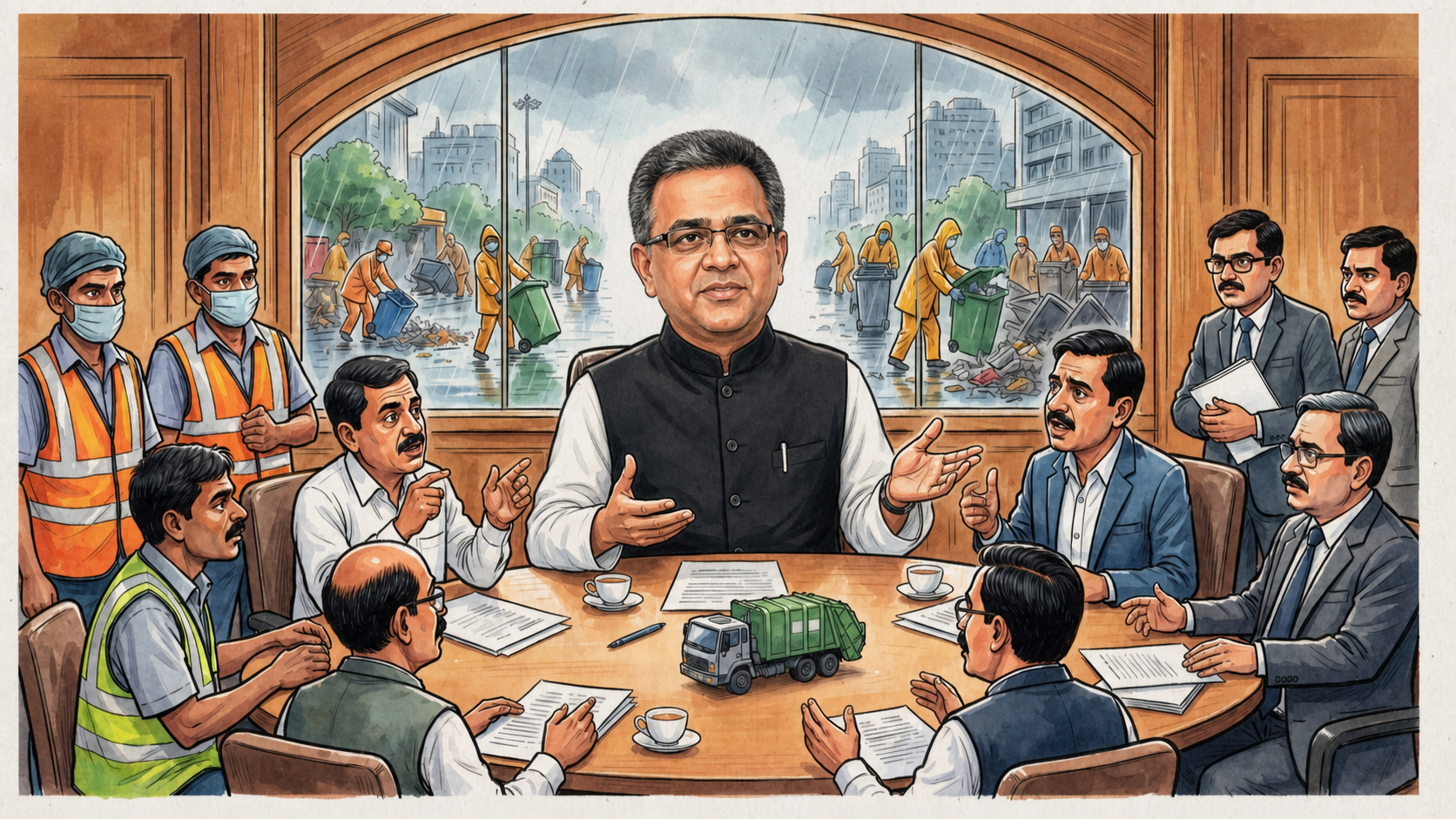
Patna can begin clearing its accumulated waste after an eight-day sanitation workers’ strike across Bihar’s urban local bodies ended on Thursday, August 6. The settlement followed a meeting between representatives of the Sanitation Workers’ Struggle Committee and Bihar Urban Development and Housing Minister Nitish Mishra. Patna Municipal Commissioner Yashpal Meena was also present.
The immediate achievement is practical: workers have withdrawn the strike and civic services can resume. The larger significance lies in the method. A citywide health and sanitation emergency was brought to a close through direct negotiation, an acknowledgement of workers’ concerns and a mechanism for unresolved questions.
What the talks produced
According to a detailed report by Patna Press, union president Chandra Prakash Singh said the government agreed to revise the consolidated pay scale for daily-wage employees and extend benefits comparable to those received by permanent employees, including leave, gratuity and bonuses.
Mishra said consensus had been reached on several demands. A committee will examine the remaining issues, while proposals requiring higher authority will be placed before the State Council of Ministers. That distinction matters: the meeting delivered a settlement, but some benefits still require formal administrative and Cabinet action before they become enforceable.
The breakthrough also rested on earlier civic-level work. The Patna Municipal Corporation Standing Committee, chaired by Mayor Sita Sahu, had reached agreement on three demands and forwarded the proposals to the Urban Development Department. The final outcome therefore reflects coordination among the workers, municipal leadership, the commissioner and the state government, with Mishra providing the ministerial forum needed to close the deadlock.
A costly warning for urban governance
The strike exposed how quickly a city’s basic systems can fail when labour relations and outsourced service contracts are not managed continuously. Municipal estimates cited in the report said more than 3,600 tonnes of garbage accumulated during the first seven days. Rain intensified foul odours and raised concern about dengue, malaria and other public-health risks.
The PMC also imposed penalties totalling ₹63.16 crore on outsourcing agencies for allegedly failing to provide the required manpower and vehicles, and issued a third show-cause notice. Those actions should now be followed by a transparent audit of contractor performance, attendance, vehicle deployment and payment cycles.
The work begins after the handshake
The settlement is a welcome example of responsive government, but its credibility will depend on implementation. Patna needs a time-bound clearance plan for the accumulated waste, ward-level progress updates and written timelines for each accepted worker demand. The proposed committee should have a clear mandate and deadline rather than becoming a holding arrangement.
Nitish Mishra’s role deserves recognition because the ministerial intervention converted a worsening civic confrontation into a negotiated path forward. The strongest proof of that leadership, however, will be visible in clean streets, reliable waste collection and workers receiving the benefits that were placed on the table.