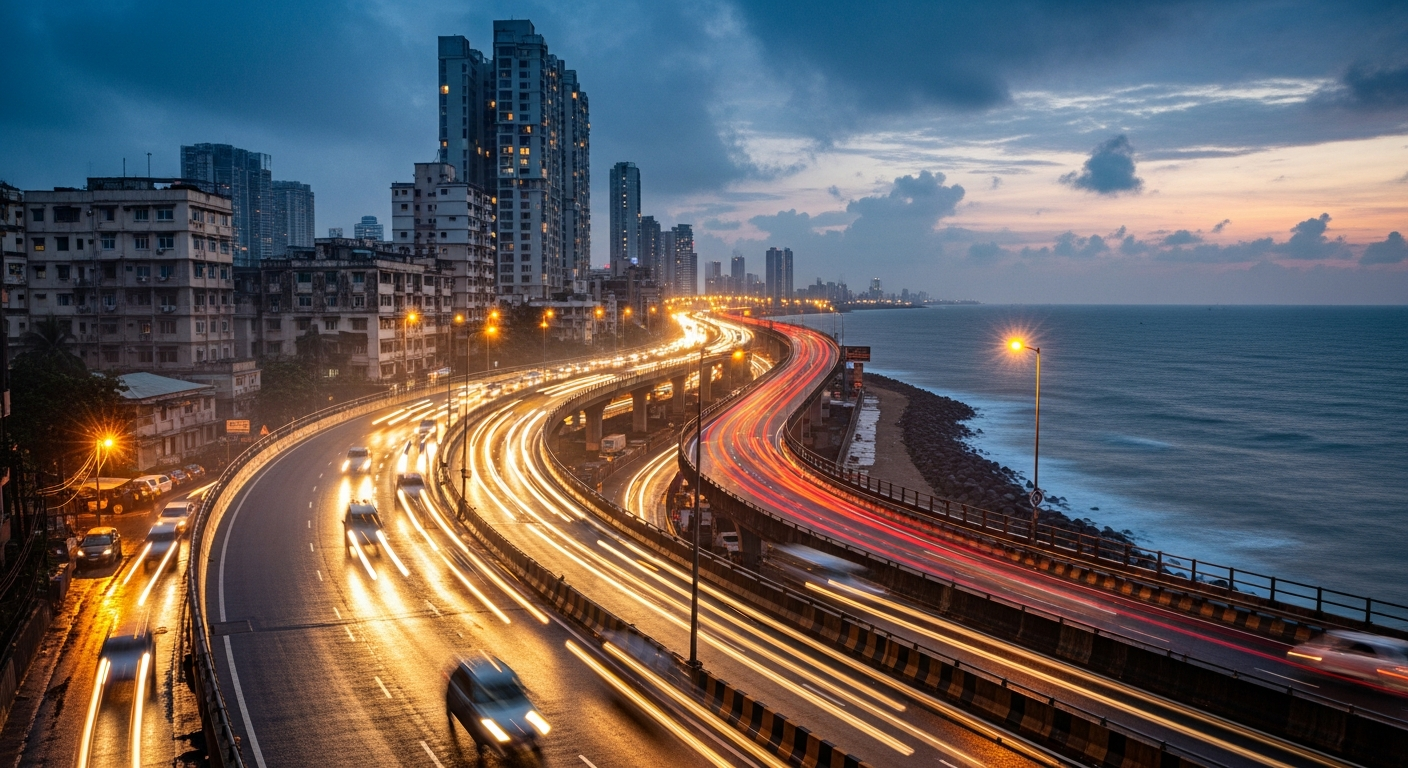
The final phase of Mumbai's coastal road opened to traffic at dawn on Monday — the elevated sea-link stretch connecting Bandra to Versova — completing a corridor that now runs unbroken from Marine Drive to the western suburbs and closing, at least in concrete, a forty-year argument about how the city should meet its sea.
The corridor's own telemetry made the first day's case: the Marine Drive-to-Versova run, 53 minutes by the internal roads at Monday peak, averaged 19 on the new alignment. The bus rapid corridor that shares the carriageway — the concession transit advocates extracted a decade ago — carried 34,000 passengers on day one across three express routes, with the dedicated lane holding its schedule through the evening peak that clogged the private carriageway within its first week of full loading.
That first-week clogging is the corridor's next argument arriving on schedule. Induced demand — the iron law by which new road capacity summons new traffic — is not a projection here but a measurement from the corridor's earlier phases, where peak volumes reached design capacity in eleven months against a projected seven years. The municipal commissioner's answer, announced with the opening, is the congestion-pricing study the city has commissioned and deferred twice before; the corridor's tolling architecture, already electronic, makes it technically trivial the day it becomes politically possible.
The settlements the project negotiated along the way open with it. The Worli and Versova fishing communities' compensation package — navigation channels through the reclamation, harbour upgrades, and the fish-market redevelopments that took three years of litigation to shape — reaches its delivery deadlines this year, and the koliwada federations have said publicly they will measure the state's word in market stalls, not press releases.
The reclaimed surface is the project's least argued and most permanent legacy: 70 hectares of continuous public green over the tunnels and alongside the carriageway, the largest addition to Mumbai's open space since the mill lands, with the first 20-hectare stretch of promenade, cycle track and mangrove buffer opening at Haji Ali this quarter.
Cities are arguments that build themselves into geography. Mumbai's coastal road — celebrated, litigated, redesigned and now complete — settles one argument and schedules its successors: pricing the corridor, keeping the transit promise, and proving the green line survives the maintenance budgets. The sea, which has watched the whole negotiation, gets the last word at every high tide.
