Current affairs · Development analysis · 14 October 2026
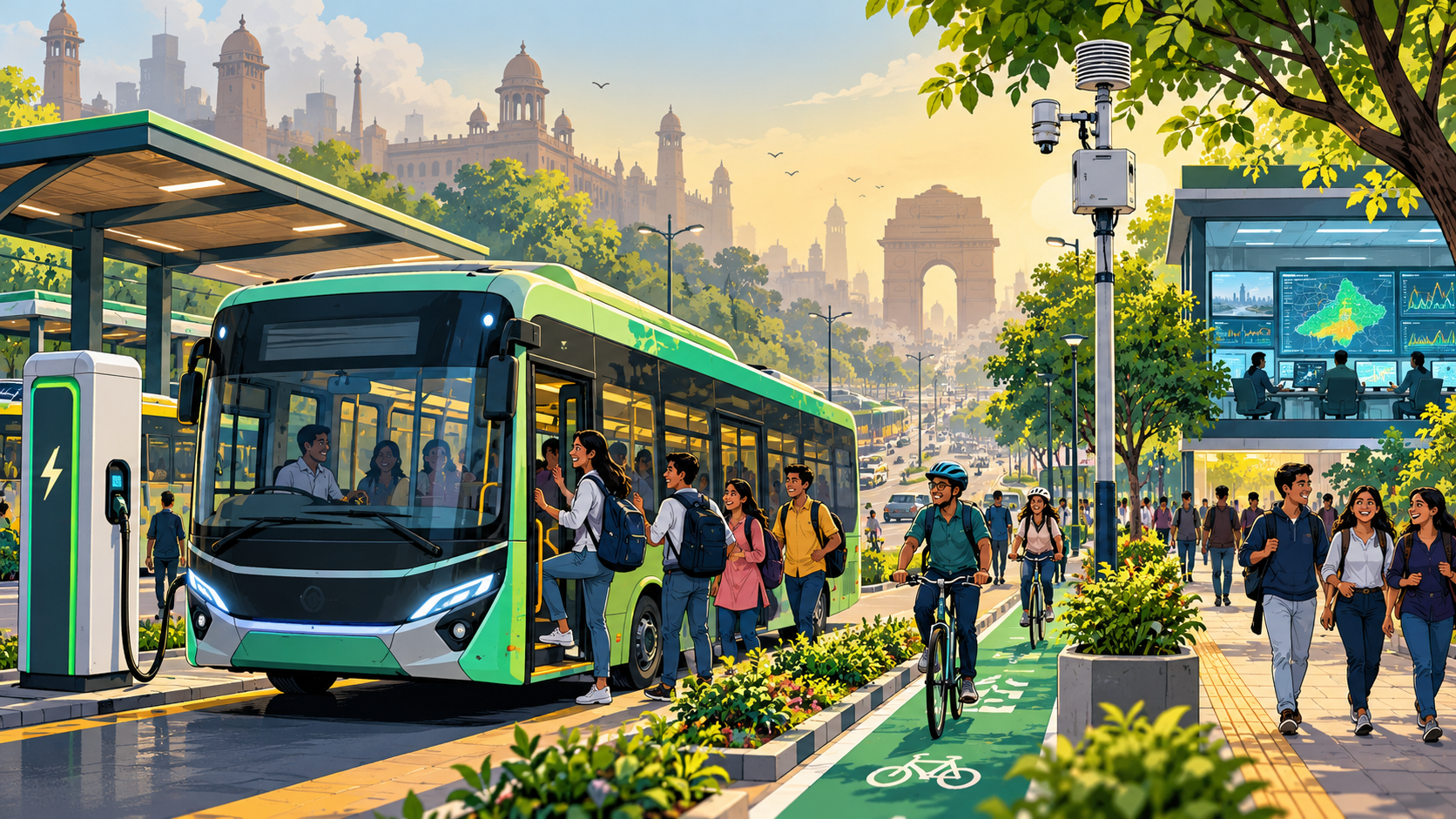
Development that reaches the bus stop
For a commuter, a transport announcement matters when a dependable bus arrives and makes a daily journey easier. Delhi’s latest electric-bus addition deserves attention because it connects a visible service improvement with the wider effort to reduce pollution. It gives the city an opportunity to make cleaner mobility part of ordinary life.
The Environment Ministry reported that Union Minister Bhupender Yadav and Delhi Chief Minister Rekha Gupta reviewed measures at Anand Vihar and visited the pollution control committee’s command centre on 13 October. The programme included 150 electric buses, charging stations at five locations and 13 new continuous air-quality monitoring stations. The ministry said the monitoring network would expand from 47 to 60 stations. PIB: Delhi mobility and air-quality measures, 13 October 2026
Cleaner vehicles need useful services
Electric buses can avoid exhaust emissions at the point where they operate, while the wider environmental footprint depends on how electricity and vehicles are produced. That distinction does not reduce the value of improving the urban fleet. It helps explain why cleaner transport should be planned alongside the electricity system and supported by sound operations.
The government’s decision to expand the fleet is most promising when it improves journeys that people already need to make. Students, workers and older residents benefit from routes that connect homes with education, employment and essential services. A vehicle’s technology becomes useful to the commuter through frequency, reliability and an understandable route network.
Consider an illustrative worker who currently waits a long time at the start of the day. A more frequent service could make that journey easier to plan. If the stop also provides shade, clear information and a safe place to board, the improvement becomes more complete. Those details give a transport investment a human measure of success.
Charging is part of the service plan
Charging infrastructure deserves attention because it influences how consistently the fleet can operate. Buses need a planned relationship between routes, depot capacity, charging schedules and maintenance. A city should be able to expand clean transport while protecting the dependable service that passengers expect throughout the day.
The five announced charging locations are a positive addition to that supporting network. The larger opportunity is to keep service planning and infrastructure planning closely connected. Operators should know how a charging interruption will be handled and where capacity may be needed as more vehicles enter service.
There is also a practical case for developing the skills required to maintain an electric fleet. Drivers, technicians and depot teams need suitable training and clear procedures. Public investment can create opportunities for skilled work when the transition is supported by a dependable maintenance system, rather than treated only as the purchase of new vehicles.
Monitoring should lead to action
The expansion of air-quality monitoring adds a second part to the announcement. Better coverage can help authorities understand where conditions are changing and examine possible causes. A sensor provides information; the public benefit depends on how that information informs inspection, prevention and follow-up.
Delhi’s pollution problem requires attention to several sources. Road dust, construction, waste burning and regional factors cannot be addressed by changing buses alone. The constructive value of the latest measures lies in combining cleaner mobility with stronger monitoring and coordinated administration. No single announcement should be read as proof that the city’s air-quality challenge has been solved.
A useful public reporting system would connect problems with action. Residents should be able to understand what was identified at a hotspot, which agency is responsible and whether the assigned task was completed. Clear reporting would help make a command centre’s work visible beyond the screens inside it.
Make the transition convenient and inclusive
A cleaner bus network can be more attractive when walking access, interchanges and passenger information are considered together. Safe footpaths help people reach a stop. Clear signs help them choose the right service. Accessible boarding and suitable space help passengers whose needs are easily missed during vehicle procurement.
These improvements are especially relevant for young residents who want affordable ways to move around the city. Public transport should feel like a sensible daily choice. The government can strengthen that choice by connecting fleet growth with careful attention to the full passenger journey, from leaving home to reaching a destination.
The new buses and monitoring stations offer a constructive foundation for that work. They are tangible additions to public-service capacity, backed by cooperation between the Union and Delhi governments. Their strongest legacy would be dependable trips, well-maintained equipment and understandable pollution follow-up. Cleaner mobility becomes a credible development story when residents can experience the improvement day after day.