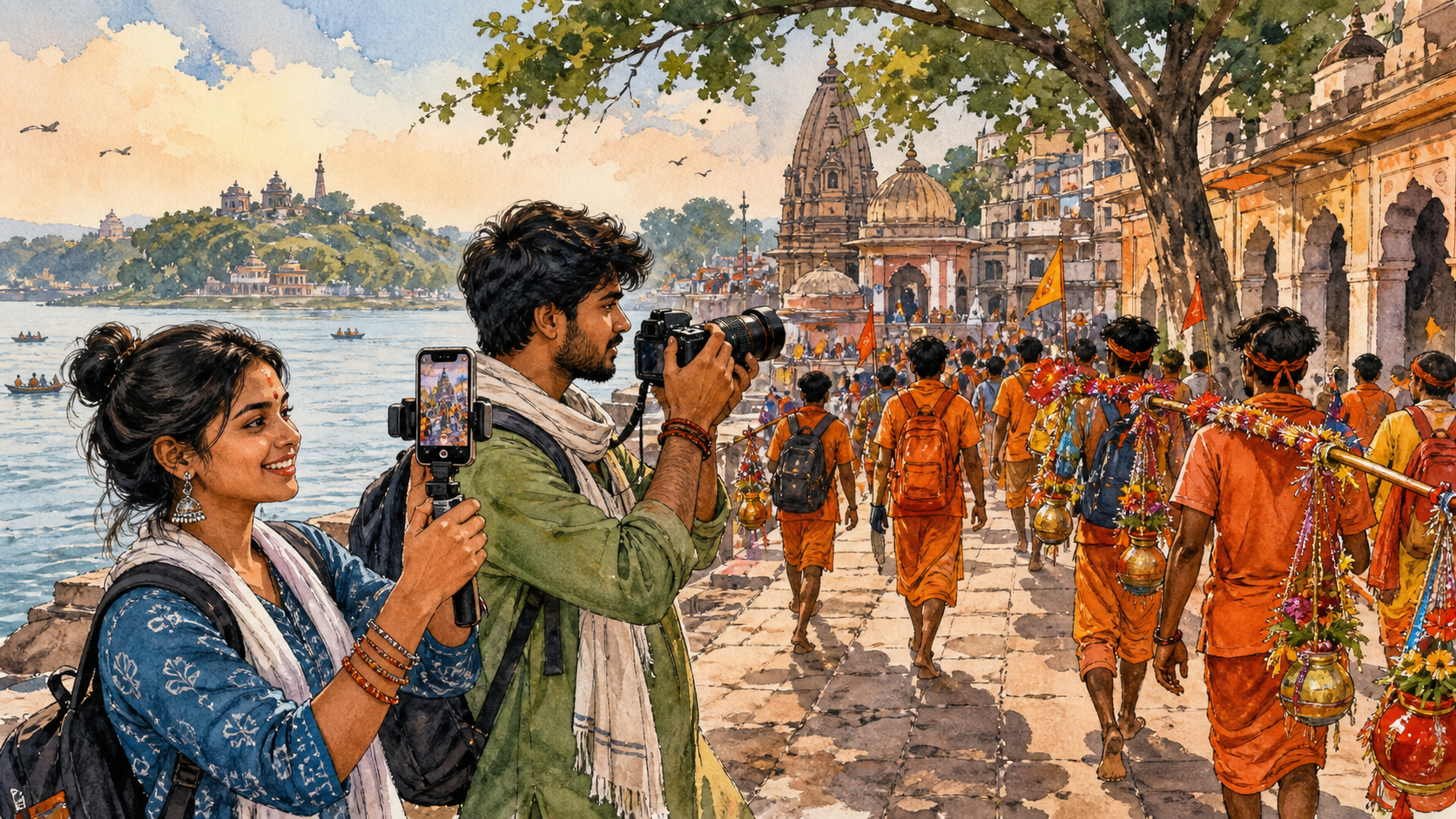
Bihar is testing a simple proposition: if millions of Indians discover destinations through short videos, tourism promotion should not remain confined to brochures and conventional advertising. The state Tourism Department’s Shrawani Mela creator competition offers cash prizes for videos documenting the pilgrimage route and its cultural landscape. It is a government-backed opportunity for influencers, but the details are more precise than the phrase “Bihar will pay influencers” suggests.
What the Programme Offers
“Shrawani Mela 2026: Through the Lens of an Influencer” is tied to the month-long fair scheduled from 30 July to 28 August. The official guidelines focus on the Kanwariya path across Munger, Banka and Bhagalpur, including the pilgrimage beginning around Sultanganj and the cultural programmes organised along the route.
The first prize is ₹3 lakh, followed by ₹2 lakh and ₹1 lakh for second and third place. Two fourth-place awards of ₹50,000 each and five consolation awards of ₹25,000 each bring the stated prize pool to ₹8.25 lakh. This is a judged competition, not an automatic payment to everyone who posts a reel.
Who Could Participate
Participants must be Indian citizens above 18 and have at least 25,000 combined followers across Facebook, Instagram, X and YouTube. Entries are required to be between 30 seconds and two minutes, in HD, geotagged and specifically connected to the designated Mela locations.
The rules also require creators to avoid controversial, objectionable or religiously hurtful material and to provide factually accurate information. Logos, watermarks and third-party rights violations are prohibited. Selected participants may be asked to provide raw footage.
One unusual condition is a complete prohibition on AI-generated material in submitted videos. That restriction may be intended to ensure that entries document the actual pilgrimage and local environment rather than synthetic scenes. It also gives the jury a practical challenge: the department should disclose how suspected AI use will be assessed and how creators can appeal an incorrect finding.
How Winners Are Chosen
The official criteria combine jury evaluation with measurable platform performance. Shortlisted videos are to be reviewed over 45 days using reach, likes and shares across departmental social-media handles. In the event of a tie, reach becomes the deciding factor.
This design rewards both storytelling and distribution. A beautiful video that nobody sees may not achieve the tourism objective; a viral video that misrepresents the Mela should not win either. The quality of the jury process will determine whether the contest balances cultural authenticity with digital popularity.
The submission schedule in the published guidelines required content to be posted after the first Somvari and supplied to the department after the second Somvari, with a specified upload date of 13 August. As of 20 August, that submission point has passed even though the Mela continues through 28 August. The administration should publish a clear shortlist and evaluation calendar so participants know the status of their entries.
Why Creator-Led Tourism Can Work
Shrawani Mela is experienced through movement: riverbanks, walking routes, temporary camps, food, devotional music, local hospitality and the discipline of a long pilgrimage. Short-form video can convey this lived environment more effectively than a static advertisement. Creators can also reach young audiences outside Bihar and members of the diaspora who may not encounter traditional state publicity.
The initiative can generate an archive of useful destination footage while giving independent creators a reason to invest time in reporting from the ground. If managed well, it can bring attention to Sultanganj, Bhagalpur, Banka and Munger beyond the pilgrimage season and encourage visitors to explore nearby heritage and cultural sites.
Payment, Disclosure and Public Trust
Government use of influencers requires transparency because audiences must know when content is part of a state-funded campaign. Prize-winning posts should carry a clear disclosure when republished. The department should publish the jury composition, scoring method, winning videos and payments made.
The guidelines grant Bihar Tourism broad rights to use, reproduce and display submitted videos globally for commercial purposes without additional compensation. Creators should understand this condition before entering. For future contests, the department could distinguish between a competition licence and a perpetual commercial licence, ensuring that public promotional needs do not unnecessarily absorb all value from a creator’s work.
This contest is also separate from Bihar’s broader Social Media and Online Media Policy, under which eligible platforms and large social accounts may seek empanelment for government advertising. Keeping competitions, paid campaigns and official advertisements clearly separated will protect credibility.
A Digital Window Into Bihar
The scheme’s promise is not that influencers can replace tourism infrastructure. A reel cannot repair a road, improve sanitation or manage a crowd. But digital attention can reveal demand, support local businesses and give administrators immediate feedback on visitor experience.
Bihar’s best tourism stories are not invented in a studio. They already exist in pilgrimage routes, archaeological sites, food traditions, rivers, crafts and living communities. The state’s task is to help credible creators document them, pay transparently for strong work and connect digital discovery with a safe, well-managed visit. The Shrawani Mela contest is a useful experiment, and its results should be evaluated in public.
